

Most FX risk management systems available today are intended for use by the largest corporations. They are delivered as Software-as-a-Service (SaaS) - complex software programs residing on a remote server. They make direct connections through the corporate firewall to enterprise resource programs (ERP) such as Oracle© or SAP©, and Treasury Management Systems such as Reval© or Wall St Systems©. This requires IT staff to oversee the complex interactions, and the finance group must learn yet another application. More importantly, the scale and expense is often well beyond what small to mid-sized enterprises (SMEs) desire.
CRM has developed its own solution architecture more suited to the SME. We do not require direct connections to ERP or TMS systems, and no IT support, so your busy finance team does not have to learn yet another complex software tool. CRM's system is cost-effective and easy to implement.
The client sends trial balance data (only items set to remeasure) and revenue/expenses to CRM via a secure file transfer protocol such as DropBox or BitTorrentSync. CRM transmits remeasurement data and trade recommendations to the client. As-executed contract data is then transmitted to CRM for incorporation into the next cycle. The complex risk management application remains within and is operated by CRM.
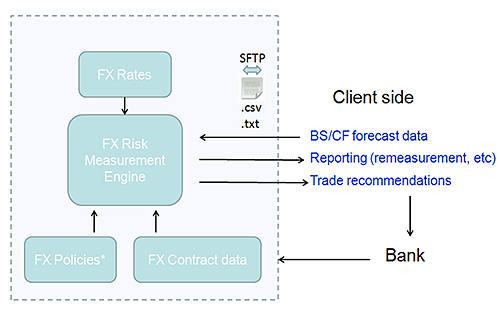
CRM's architecture shields clients from complexity and lets clients focus on their core business, not on complex hedging structures.
In keeping with the philosophy of minimal impact on your staff, CRM's schedule of data transfers is very efficient, requiring either two or three "data days". If you need to determine the upcoming month's cash requirements by mid-month, the process requires three "data days":
If your cash planning can wait until the last work day of the current month, then the process can be simplified even more by combining steps 1 & 3, requiring just two "data days":
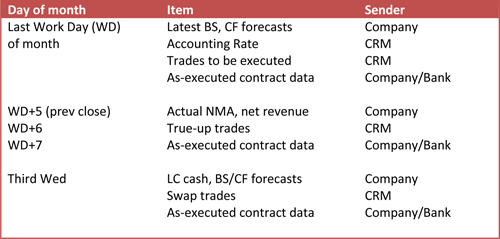
Process for early cash requirement determination
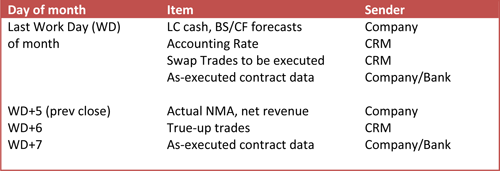
Simplified process when cash requirements aren't critical

©2014 Currency Risk Management. All Rights Reserved. The content on this website is provided "AS IS", without any express or implied warranty.